Best Power Wheels for Grass: What Actually Works on a Real Lawn
The best ride-on cars for grass — minimum 12V, specific models tested on real lawns. Which handle thick grass and gentle slopes, and which are driveway-only toys in disguise.
Affiliate Disclosure
This page contains affiliate links. As an Amazon Associate, PowerWheels HQ may earn a commission on qualifying purchases at no extra cost to you. Our reviews and recommendations are editorially independent.
Looking for the best power wheels for grass? Our top pick is the Polaris RZR 900 24V. It leads this guide as best overall — handles the most demanding grass and slopes with a 4.9/5 rating. The full comparison and the tradeoffs are below.
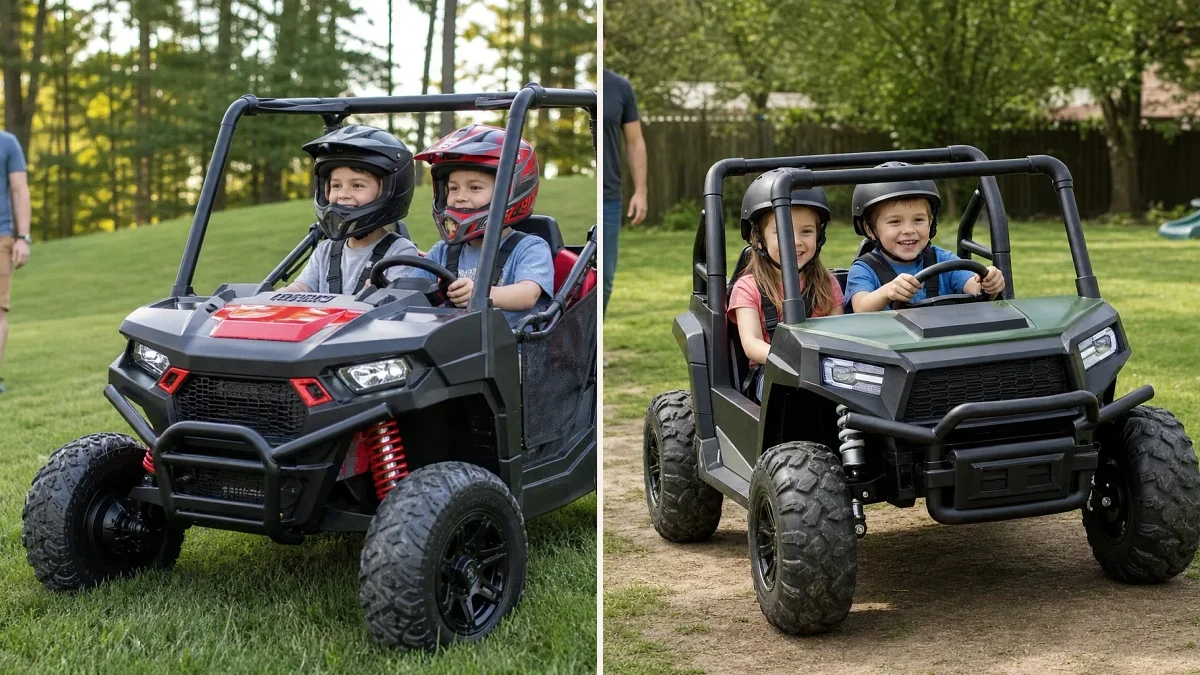
If you have a real lawn — not a golf fairway, but an actual family yard with thick grass, occasional bare spots, maybe a gentle slope — grass performance is the only thing that matters when choosing a ride-on toy. A vehicle that looks incredible on a showroom floor or Amazon photo but bogs down the moment it hits your lawn is a $300 disappointment.
The honest filter: 6V is a driveway toy. Period. It will not move a child across real grass. Most 12V models handle moderate grass reasonably well. On thick, lush, or slightly wet grass — the kind that pushes back — many 12V motors struggle. 24V is where performance on challenging terrain starts to become genuinely reliable.
The Grass Problem Explained
Grass creates rolling resistance. The taller, thicker, or wetter the grass, the more resistance. A 6V motor pushing a 35-lb child encounters enough resistance from ordinary lawn grass to slow significantly or stall. A 12V motor handles the same resistance with most kids but will struggle on thick, damp grass or gentle hills. A 24V motor handles both.
The other grass factor: motor heat. A motor working at the edge of its capability runs hot. On a flat driveway, a 12V motor at 80% capacity runs cool. On thick grass, that same motor at 100% capacity runs hot — and eventually the thermal cutoff shuts it down. If your child's ride-on is constantly stopping mid-use and restarting after a cooldown period, grass resistance is probably overloading the motor.
Tires Matter More Than People Realize
Rubber tires grip grass better than hard plastic. This sounds obvious but is frequently overlooked in feature comparisons. Many budget ride-ons use hard plastic wheels — they look fine in photos and work acceptably on pavement. On grass, they're comparatively worse than the rubber-tired alternatives. Look for "real rubber tires" or "all-terrain tires" in the product specs.
Tread pattern helps too, though less dramatically than material. The deep tread on an ATV-style tire provides more bite in soft or wet conditions than a car-style tread.
The Peg Perego Advantage
Peg Perego makes the best ride-on vehicles for grass performance. Their motors are genuinely more powerful than the Fisher-Price Power Wheels equivalents at the same nominal voltage, their construction is more robust, and their rubber tires are better specified for outdoor use.
The Peg Perego Polaris RZR 900 and the Peg Perego John Deere Ground Force are the benchmarks in their categories. If grass performance is the primary criterion, start there.
That said, Peg Perego vehicles are premium-priced — $300–$650 depending on the model. If the budget is tighter, there are capable Power Wheels models that handle moderate grass, and several third-party options that perform well at 12V.
Speed vs. Torque
Grass driving requires torque, not speed. The vehicles that handle grass best are not necessarily the fastest on pavement — they're the ones with the most turning force at the motor output. Higher-torque motors pull through resistance; high-speed motors rely on momentum and struggle when resistance slows them.
When reading specs, "dual motor" is often a torque indicator as much as a speed indicator. Two motors distributing the load to both rear wheels generate more total torque than a single motor driving through a differential. Look for dual-motor configurations if grass is your terrain.
Slopes: When 12V Isn't Enough
A gentle 5–7 degree slope is where 12V performance starts to separate the good from the inadequate. Most 12V motors can handle level or nearly level grass. Add a slope — even a gentle one — and you're combining gravity resistance with grass resistance, and many 12V motors can't sustain the load.
If your yard has a genuine slope (not just "slightly uneven" but a real grade), go 24V. There is no budget workaround for a slope with thick grass and a 40-lb child. The physics require the power.
The Models That Deliver
Below are the specific vehicles that have demonstrated real grass performance — not just adequate driveway performance, not just "handles light grass," but genuine performance on a real family lawn.
Quick Comparison
Polaris RZR 900 24V
Peg Perego
Best overall — handles the most demanding grass and slopes
- Voltage
- 24V
- Seats
- 2
- Ages
- 4-10
- Price
- $500-$650
John Deere Ground Force 12V
Peg Perego
Best 12V for grass — Peg Perego motor advantage
- Voltage
- 12V
- Seats
- 1
- Ages
- 3-7
- Price
- $280-$380
Dune Racer Extreme 24V
Power Wheels
Best value 24V for grass
- Voltage
- 24V
- Seats
- 2
- Ages
- 4-8
- Price
- $350-$450
Ford F-150 Raptor 12V
Power Wheels
Best 12V truck for moderate grass
- Voltage
- 12V
- Seats
- 1
- Ages
- 3-7
- Price
- $300-$400
Freddo 24V Electric Jeep
Freddo
Budget-friendly 24V for real grass
- Voltage
- 24V
- Seats
- 2
- Ages
- 3-8
- Price
- $280-$380
| Product | Best For | Specs | Price | Rating |
|---|---|---|---|---|
Polaris RZR 900 24V Peg Perego | Best overall — handles the most demanding grass and slopes | 24V · 2 seats Ages 4-10 | $500-$650 | 4.9 |
John Deere Ground Force 12V Peg Perego | Best 12V for grass — Peg Perego motor advantage | 12V · 1 seat Ages 3-7 | $280-$380 | 4.7 |
Dune Racer Extreme 24V Power Wheels | Best value 24V for grass | 24V · 2 seats Ages 4-8 | $350-$450 | 4.5 |
Ford F-150 Raptor 12V Power Wheels | Best 12V truck for moderate grass | 12V · 1 seat Ages 3-7 | $300-$400 | 4.6 |
Freddo 24V Electric Jeep Freddo | Budget-friendly 24V for real grass | 24V · 2 seats Ages 3-8 | $280-$380 | 4.3 |
Prices are approximate and subject to change. Always verify current pricing before purchasing.
Our Picks — In Detail
Polaris RZR 900 24V
Peg Perego
24VSeats
2Ages
4-10Price
$500-$650
The benchmark for grass performance. Dual 24V motors with genuine all-terrain tires, 130-lb weight capacity, and Peg Perego's construction quality make this the vehicle that handles everything a real yard can throw at it — including slopes, thick grass, and gravel.
Pros
- Best-in-class grass and slope performance
- Dual 24V motors — genuine torque
- 130-lb capacity handles older kids
Cons
- Most expensive ride-on in this category
- Large footprint — needs real storage space
John Deere Ground Force 12V
Peg Perego
12VSeats
1Ages
3-7Price
$280-$380
At 12V, the Ground Force's motor outperforms most competitors' 12V motors on grass. Rubber tires, deliberate (but adequate) speed, and Peg Perego's quality construction combine to make this the best 12V option for a real lawn. Not as capable as the 24V RZR on slopes, but excellent on level or gently sloped grass.
Pros
- Peg Perego 12V motor exceeds competing 12V performance
- Rubber tires provide real grip on grass
- Working front loader bucket
Cons
- Slower than UTV-style vehicles by design
- Slopes with thick grass still challenge a 12V
Dune Racer Extreme 24V
Power Wheels
24VSeats
2Ages
4-8Price
$350-$450
Power Wheels' answer to the grass performance question: a 24V platform with rubber tires and enough motor power to handle real outdoor terrain. Not as premium as Peg Perego but performs significantly better on grass than any 12V Power Wheels, at a lower price than the Peg Perego 24V options.
Pros
- 24V power at a more accessible price than Peg Perego
- Two seats for sibling rides
- Rubber tires for real grass grip
Cons
- Power Wheels build quality below Peg Perego
- Larger kids may outperform it on serious slopes
Ford F-150 Raptor 12V
Power Wheels
12VSeats
1Ages
3-7Price
$300-$400
The best 12V Power Wheels for outdoor performance. The wide wheelbase provides stability on uneven terrain, the rubber tires grip reasonably on real grass, and the 130-lb weight capacity means it's not straining at the motor for most kids. For moderate grass without significant slopes, it's a capable choice.
Pros
- Rubber tires — genuine grass grip
- 130-lb capacity — not overloaded by most kids
- Wide wheelbase for stability on uneven terrain
Cons
- 12V struggles on thick grass with slopes
- Large and heavy for the 12V category
Freddo 24V Electric Jeep
Freddo
24VSeats
2Ages
3-8Price
$280-$380
24V performance at a lower price than the Peg Perego and Power Wheels Dune Racer. Build quality is a step below both, but the dual 24V motors handle grass well for the price. A reasonable option if the Peg Perego budget isn't realistic.
Pros
- 24V performance at a budget-friendlier price
- Dual motors provide good torque
- Two-seater design
Cons
- Build quality below Peg Perego and Power Wheels
- Brand reliability less proven over long-term use
What to Look For
Voltage (6V / 12V / 24V)
Higher voltage means more power, higher top speed, and better terrain handling. Choose based on your child's age, size, and where they'll ride. 12V is the most popular choice for ages 3–7.
Number of Seats
Single-seat models work for one child; two-seat designs are great for siblings or friends. Two-seaters often put more strain on the motor, so look for adequate power.
Terrain
Most 12V ride-ons handle flat grass and hard surfaces. If you have hills, rough grass, or gravel, look for 24V models with high-traction tires.
Safety Features
Look for seat belts, parental lockout switches, low/high speed settings, and parental remote controls — especially for younger or first-time riders.
Battery & Charging
Check battery life (usually 1–2 hours for 12V) and charge time (8–18 hours). Some premium models offer faster charging or higher-capacity batteries.