24V vs. 36V Ride-On Toys: This Is a Category Change, Not an Upgrade
24V vs. 36V ride-on toys explained: why 24V is the ceiling for driveway ride-on cars, why 36V means dirt bikes and go-karts, and how to pick for a 6-10 year old.
Affiliate Disclosure
This page contains affiliate links. As an Amazon Associate, PowerWheels HQ may earn a commission on qualifying purchases at no extra cost to you. Our reviews and recommendations are editorially independent.
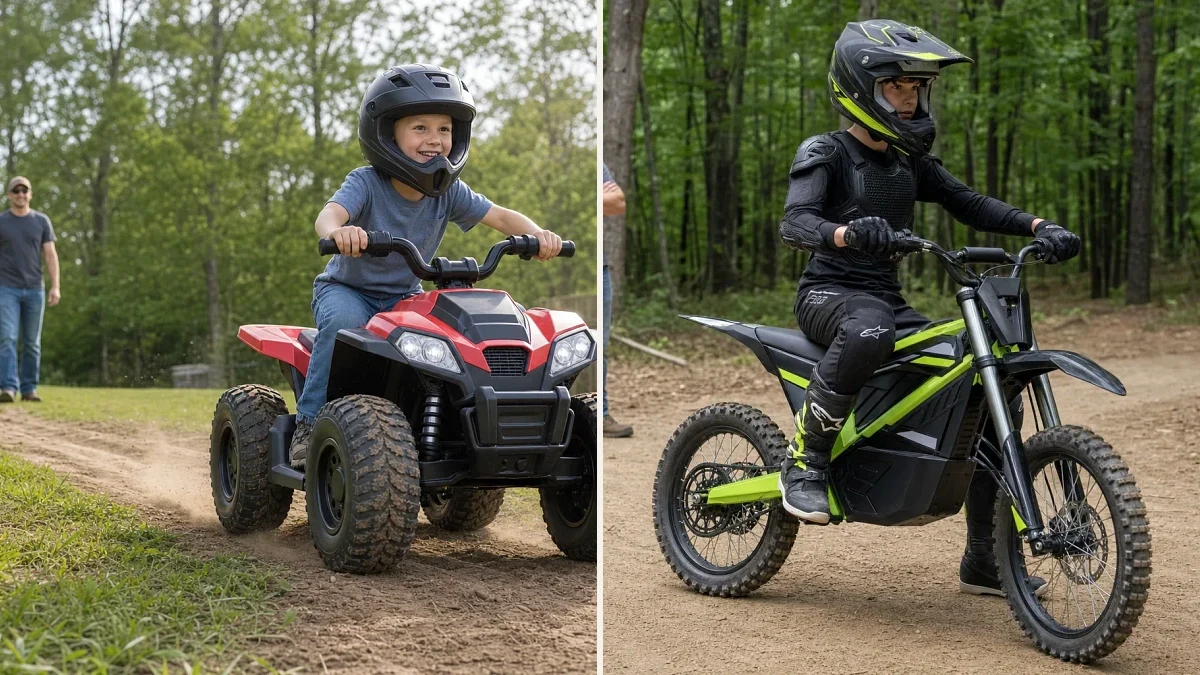
If your kid is 6-10 and you're deciding between 24V and 36V, here's the answer: 24V is the ceiling of the ride-on toy world — the two-seat UTVs, buggies, and karts that live in the driveway and yard at 5-12 mph. 36V is the floor of a different world entirely: dirt bikes and drift karts running 14-17 mph, where helmets are mandatory, supervision is non-negotiable, and "toy" stops being the right word.
So don't ask "should I get more volts?" Ask "is my kid ready to leave ride-on toys?" That's the actual question, and it has less to do with age than with judgment.
What 24V Actually Gets You
24V is the performance tier of the traditional ride-on category. The Peg Perego Polaris RZR 900 does 7 mph with two kids aboard on grass. The Razor Dune Buggy does 8 mph inches off the ground. The Razor Ground Force Drifter kart reaches 12 mph on smooth pavement. Razor's MX350 dirt bike — technically a 24V system — hits 14 mph and sits right at the border of the two worlds.
The unifying trait: these vehicles still operate at speeds where a jogging adult can intervene, still work in a yard or driveway, and (dirt bike excepted) still function with a bike helmet and common sense. For most 6-8 year olds, a good 24V vehicle is not a compromise. It's the correct destination, with years of use in it.
What 36V Actually Means
There are essentially no 36V ride-on cars. When you cross into 36V, the products change shape: the Razor MX500 and MX650 dirt bikes (15 and 17 mph), the Crazy Cart XL, and the upper tier of drift and go-kart machines. The voltage isn't the point — the category is. These are single-rider machines with real acceleration, real braking technique, and real consequences, designed for 12+ (or a seriously experienced 10-11 year old).
At 17 mph, a fall is not a tumble on the lawn. A full-face helmet, gloves, and pads are standard equipment, and the riding surface matters — open grass fields and dirt for the bikes, smooth empty pavement for the karts. If reading that paragraph felt heavy, that's the honest signal that your kid isn't there yet. Nothing wrong with that.
The Trap: Buying 36V "So They Don't Outgrow It"
This is the same mistake as buying a 13-year-old's dirt bike for a 9-year-old, and it fails the same way. A kid who isn't ready for 15+ mph doesn't grow into it sitting in the garage — they either ride scared or ride recklessly, and both are worse than riding a 24V machine confidently. The progression that works: master the 24V tier, demonstrate judgment (stopping distances, awareness of people and cars, respect for boundaries), then step up.
Meanwhile, the reverse mistake barely exists. Nobody regrets that their 7-year-old's Ground Force Drifter is "only" 12 mph. Twelve mph in an open kart is plenty of drama.
Batteries, Charging, and Cost Reality
Both tiers use sealed lead-acid packs in most models, and both share the honest limitation of the breed: 30-40 minutes of hard riding, then an overnight charge. 36V machines cost more up front ($380-550+ versus $250-450 for good 24V vehicles), and replacement battery sets cost more too, since you're replacing three 12V cells instead of two.
One more cost nobody budgets: gear. If you're going 36V, add $60-120 for a proper helmet and pads before the vehicle ships. It's not optional and it's not later.
The Decision in One Paragraph
Ages 6-8, riding in a yard or driveway, sharing with siblings, bike-helmet supervision: buy the best 24V vehicle you can and don't look at 36V again for two years. Ages 10+, experienced on a 24V machine, with open space and a parent willing to enforce gear: 36V is the legitimate next step — as a dirt bike or kart, because that's what 36V is.
Quick Comparison
Peg Perego Polaris RZR 900
Peg Perego
The best of the 24V ride-on world — 7 mph, two seats, real terrain
- Voltage
- 24V
- Seats
- 2
- Ages
- 3-8 years
- Price
- $550-$700
Razor Dune Buggy
Razor
Best 24V thrill machine — 8 mph feels fast at ground level
- Voltage
- 24V
- Seats
- 1
- Ages
- 8+
- Price
- $300-$400
Razor Ground Force Drifter
Razor
Best 24V go-kart — 12 mph on smooth pavement
- Voltage
- 24V
- Seats
- 1
- Ages
- 8+
- Price
- $250-$350
Razor MX500 Dirt Rocket
Razor
The gentlest entry into the 36V world — 15 mph
- Voltage
- 36V
- Seats
- 1
- Ages
- 10-14 years
- Price
- $380-$470
Razor MX650 Dirt Rocket
Razor
The destination 36V machine — 17 mph, 220 lb limit
- Voltage
- 36V
- Seats
- 1
- Ages
- 12+
- Price
- $450-$550
Razor Crazy Cart XL
Razor
36V on four wheels — the drift machine for teens and adults
- Voltage
- 36V
- Seats
- 1
- Ages
- 16+
- Price
- $500-$650
| Product | Best For | Specs | Price | Rating |
|---|---|---|---|---|
Peg Perego Polaris RZR 900 Peg Perego | The best of the 24V ride-on world — 7 mph, two seats, real terrain | 24V · 2 seats Ages 3-8 years | $550-$700 | 4.7 |
Razor Dune Buggy Razor | Best 24V thrill machine — 8 mph feels fast at ground level | 24V · 1 seat Ages 8+ | $300-$400 | 4.4 |
Razor Ground Force Drifter Razor | Best 24V go-kart — 12 mph on smooth pavement | 24V · 1 seat Ages 8+ | $250-$350 | 4.3 |
Razor MX500 Dirt Rocket Razor | The gentlest entry into the 36V world — 15 mph | 36V · 1 seat Ages 10-14 years | $380-$470 | 4.5 |
Razor MX650 Dirt Rocket Razor | The destination 36V machine — 17 mph, 220 lb limit | 36V · 1 seat Ages 12+ | $450-$550 | 4.7 |
Razor Crazy Cart XL Razor | 36V on four wheels — the drift machine for teens and adults | 36V · 1 seat Ages 16+ | $500-$650 | 4.4 |
Prices are approximate and subject to change. Always verify current pricing before purchasing.
Our Picks — In Detail
Peg Perego Polaris RZR 900
Peg Perego
24VSeats
2Ages
3-8 yearsPrice
$550-$700
The top of the traditional ride-on category. Seven mph with two kids aboard, three speed settings, and 24V power that handles grass and hills 12V vehicles can't. If your kid is under 8, this is what "upgrading" should mean — not a dirt bike.
Pros
- 7 mph with passengers on real terrain
- Three parent-controlled speed settings
- Build quality that survives multiple kids
Cons
- Premium price for the category
- Kids chasing real speed will still want more by 9-10
Razor Dune Buggy
Razor
24VSeats
1Ages
8+Price
$300-$400
Eight mph in an open-frame buggy with your seat inches off the ground. Speed is experienced relative to proximity to the dirt, and the Dune Buggy exploits that brilliantly — big thrills while staying inside the supervisable 24V world. The smart middle step before any 36V machine.
Pros
- Ground-level seating makes 8 mph feel dramatic
- Chain drive and knobby tires — real hardware
- Thrilling without leaving bike-helmet territory
Cons
- Single seat — no sibling sharing
- 120 lb weight limit caps the usable years
Razor Ground Force Drifter
Razor
24VSeats
1Ages
8+Price
$250-$350
Twelve mph in a low-slung kart with rear slider wheels for controlled drifts. This is the fastest most families ever need to go on four wheels, and it's still a 24V machine with 24V pricing. Needs smooth pavement and open space to shine.
Pros
- 12 mph is the top of the 24V four-wheel world
- Drift-capable rear wheels add a skill dimension
- Cheaper than any comparable 36V machine
Cons
- Useless on grass — smooth pavement only
- Low profile demands an area with no car traffic
Razor MX500 Dirt Rocket
Razor
36VSeats
1Ages
10-14 yearsPrice
$380-$470
What 36V actually looks like: not a faster ride-on car, but a mid-size electric dirt bike. Fifteen mph, 36V chain drive, 175 lb weight limit. If your kid has mastered a 24V machine and wants the next world, this is its most forgiving doorway.
Pros
- 36V responsiveness on a manageable mid-size frame
- 175 lb limit covers riders into their mid-teens
- Less intimidating step-up than the MX650
Cons
- Requires full protective gear and open space
- Not a yard toy — this is a real vehicle
Razor MX650 Dirt Rocket
Razor
36VSeats
1Ages
12+Price
$450-$550
The top of Razor's electric line and the clearest illustration that 36V is a different category. Seventeen mph, full motocross geometry, a frame that carries lighter adults. Nobody supervises this from a lawn chair — and that's exactly the point of the tier.
Pros
- 17 mph with torque that handles hills and big riders
- 220 lb capacity means it's never outgrown
- The last stop before gas-powered bikes
Cons
- Completely inappropriate for kids under 12
- Full-face helmet and pads are mandatory equipment
Razor Crazy Cart XL
Razor
36VSeats
1Ages
16+Price
$500-$650
Proof that 36V four-wheelers exist — and that they're not for children. The XL is the full-size version of Razor's drift cart, rated for riders up to 240 lbs, and it's marketed as much to adults as to teens. Included here to calibrate expectations: this is what four wheels at 36V means.
Pros
- Full drift capability with serious power
- 240 lb capacity — genuinely adult-rated
- The most fun-per-dollar in the teen/adult drift niche
Cons
- Rated 16+ — not a kids' purchase at all
- Demands a large, smooth, empty surface
What to Look For
Voltage (6V / 12V / 24V)
Higher voltage means more power, higher top speed, and better terrain handling. Choose based on your child's age, size, and where they'll ride. 12V is the most popular choice for ages 3–7.
Number of Seats
Single-seat models work for one child; two-seat designs are great for siblings or friends. Two-seaters often put more strain on the motor, so look for adequate power.
Terrain
Most 12V ride-ons handle flat grass and hard surfaces. If you have hills, rough grass, or gravel, look for 24V models with high-traction tires.
Safety Features
Look for seat belts, parental lockout switches, low/high speed settings, and parental remote controls — especially for younger or first-time riders.
Battery & Charging
Check battery life (usually 1–2 hours for 12V) and charge time (8–18 hours). Some premium models offer faster charging or higher-capacity batteries.